The Council Culture Academy
Explore our growing library of multimedia online programmes, designed specifically for clerks, councillors and officers who want to build modern, effective councils.
Each course sits within one of four core pillars:
Council Culture. Strengthening internal dynamics, psychological safety and professional conduct.
Communication & Community Engagement. Building trust, clarity and meaningful connection with your residents.
Personal Development. Developing confidence, resilience and emotionally intelligent leadership.
Skills & Talent Growth. Enhancing practical capability. Use of AI, Canva and training for council communications officers.
A full council licence reduces the individual price by 60 per cent. Just add 10 seats at the checkout to see the discount and apply it.
What the Academy Is
The Council Culture Academy is a growing library of online courses
Each course includes:
• Video modules
• Around five structured sections per course, depending on topic
• Downloadable worksheets and tools
• Completion certificates
• 12 months access
• Unlimited rewatching
It is designed for whole-council learning. Especially councillors, Chairs, committee leads and officers supporting public engagement.
How It Works
Each participant receives their own login.
Clerks or administrators with a council licence can view usage data, so you can monitor engagement across the council.
Courses can be:
• Used as induction for new members
• Assigned ahead of a strategy day
• Used after in-person training to reinforce learning
• Watched individually or discussed collectively
This makes learning continuous rather than event-based.
Individual Seats or Council Licence
Courses are available as:
• Individual seats
• Council licences of 10 places or more, scalable upward
A full council licence reduces the individual price by 60 per cent. Just add 10 seats at the checkout to see the discount and apply it.
Additional seats can be added at any time.
I strongly encourage councils to purchase group access.
One of the quiet fractures in council life is knowledge being held by a few.
When only some members understand communication dynamics, psychological safety or public narrative, imbalance grows.
Shared learning reduces silos.
It strengthens collective responsibility.
It reduces misinterpretation.
What Makes This Different
This is not compliance training. It is cultural infrastructure.
We focus on human dynamics.
Good communication is not just about wording.
It is about:
• Nervous systems
• Belonging
• Clarity
• Psychological safety
• Collective responsibility
That is what turns a council into a trusted local hub.
Works Alongside In-Person Training
If you have worked with me in person, these courses reinforce and extend that work.
They can act as a precursor to in-person training or strategy-building days.
Live Q&A’s via webinar can take place after the whole council course training.
And they stand alone.
Access and Updates
You receive 12 months access from the date of enrolment.
Courses can be revisited as often as needed.
Where content is updated, councils retain access to the latest version within their access period.
Learning stays relevant.
When to Use It
The Academy works particularly well:
• After elections
• During chair transitions
• When launching a new communications strategy
• When internal tone feels strained
• When strengthening community trust
• When onboarding new councillors
Healthy communication inside the council creates healthier communication outside it.
Healthier communication builds trust.
Trust strengthens wellbeing.
That ripple effect matters.
This is about building a council culture that people are proud to be part of.
Doors just open video
Multimedia online courses -
Council Culture. Strengthening internal dynamics, psychological safety and professional conduct.
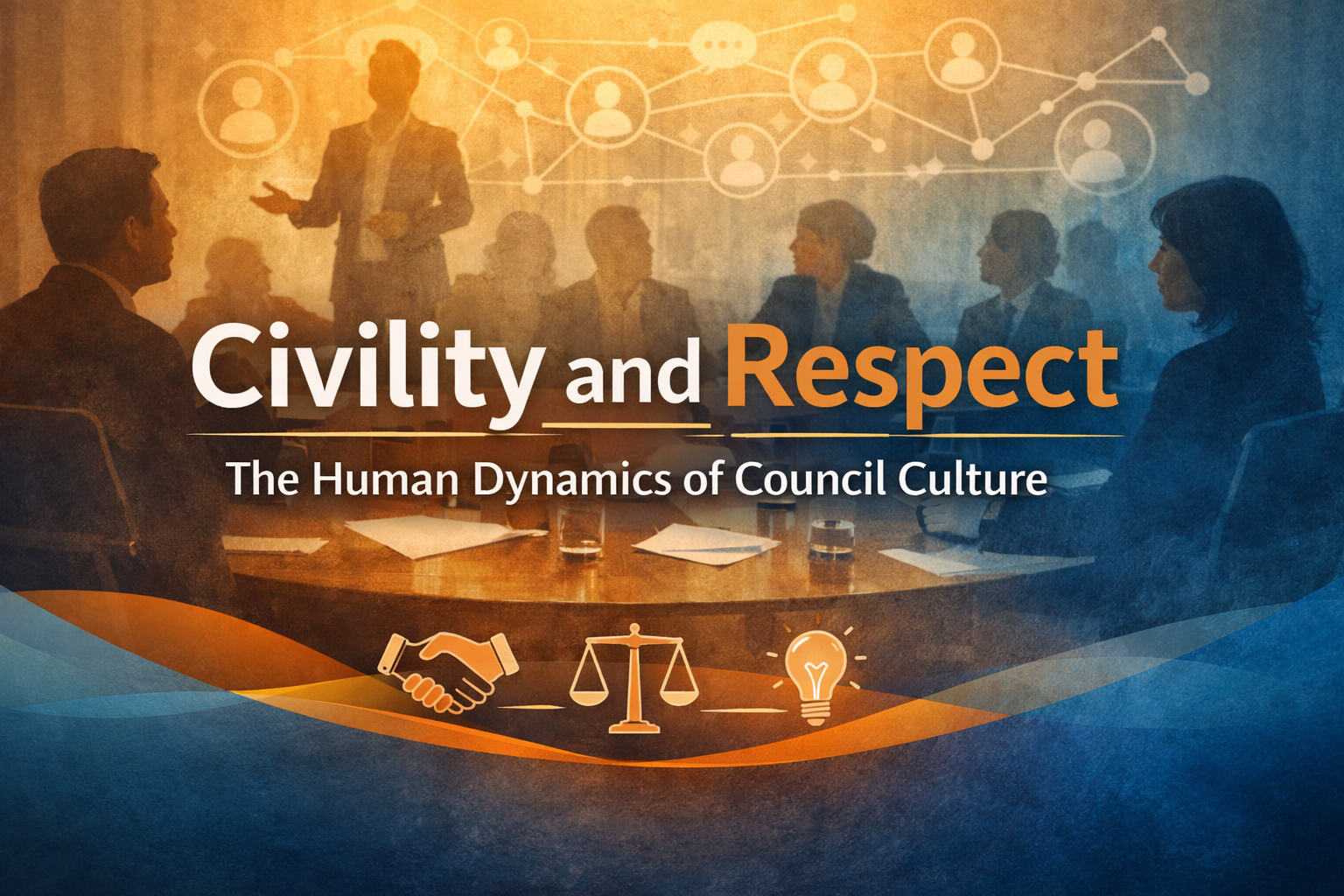
Civility and Respect. The Human Dynamics of Council Culture
We explore the human dynamics that shape behaviour inside councils. Why meetings escalate. Why email tone shifts. Why debate turns personal. And how repair becomes possible.
Grounded in psychology and real council experience, this training is for everyone within the council. It connects the principles of the Code of Conduct to everyday communication, power dynamics and emotional regulation.
The Council Strategy Blueprint - Build a Living Strategy Without the Spreadsheet Overwhelm
This course shows you how to build a living strategy that actually guides decisions. You will learn how to turn values into practical filters, so the council and the community understand what you stand for and why projects are chosen. We strip away complexity and replace it with clarity.
A strategy that works in the room, not just on paper.
Thinking Differently in Council Culture - How Council Life Feels for Every Mind
Council life isn’t experienced in one way. Some people feel energised in meetings. Others feel overwhelmed. Some speak easily. Others process quietly. And too often, what gets labelled as “difficult”, “disengaged”, or “overthinking” is simply a different way of thinking at work. This course opens up the reality of how council life actually feels for different minds. Through real conversations with people working in councils, you’ll start to see what’s happening beneath behaviour. In meetings, in emails, and in decision-making. You’ll also discover the small changes that make a big difference.
Public Communication & Community Engagement. Building trust, clarity and meaningful connection with your residents.
Write Surveys People Actually Want to Answer
Most council surveys struggle to get the response they deserve. They can feel a bit long or unclear, and sometimes people aren’t quite sure how their input will be used. When that happens, response rates drop and valuable insight is missed.
This course shows you how to change that. You will learn how to write surveys people actually want to complete, increase response rates and ask better questions that lead to useful answers. It draws on real council experience and focuses on practical tools you can use straight away.
By the end, you will feel confident sending surveys that not only gather information but strengthen your relationship with your community.
Skills & Talent Growth. Enhancing practical capability. Use of AI, Canva and training for council communications officers.
AI in Council Work: Essential skills for Effective use
This is a living course, which means as AI develops, new lessons and updates will be added so you and your council stay up to date with the tools that are most useful for council work during your access period. The course covers everything from writing effective prompts to building your own Council GPT assistants. All teaching is focused on practical use within ChatGPT accounts so you can apply what you learn immediately in your council role. Many councils pay external providers thousands of pounds to build internal AI assistants. This course shows you how to build them yourself.
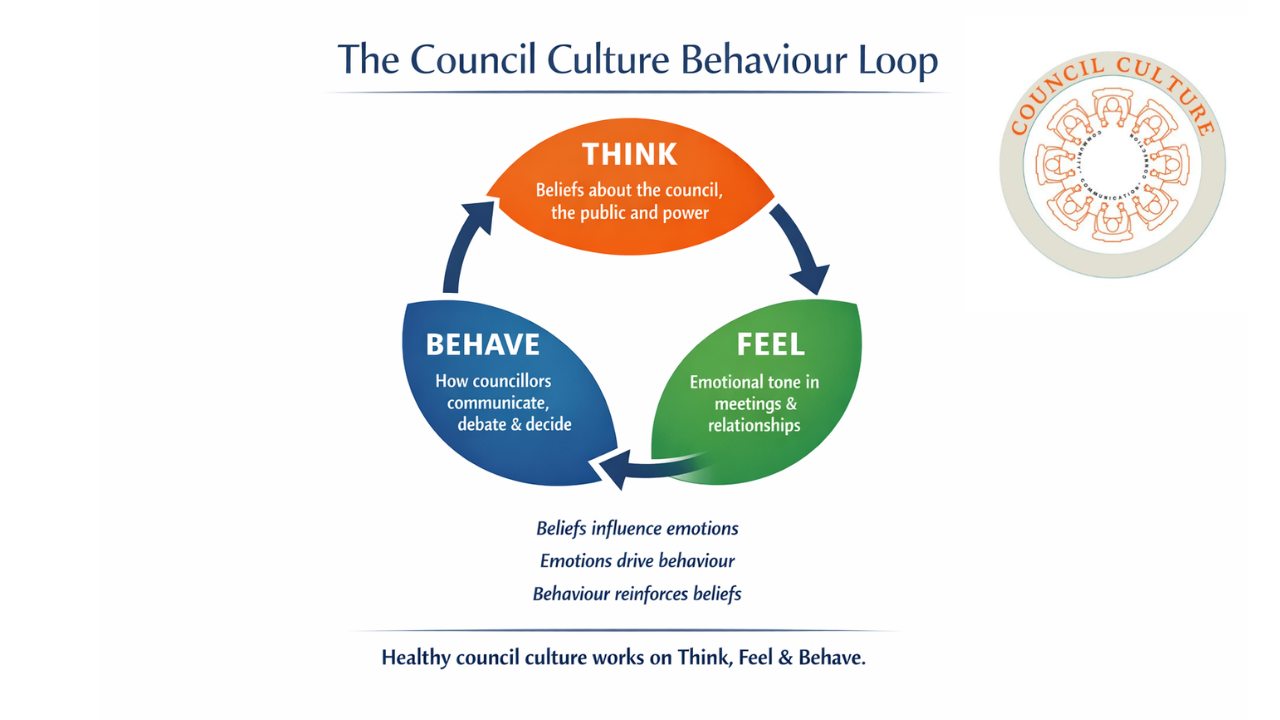
Our Learning Framework - The Council Culture Behaviour Loop
Many councils try to solve behaviour problems by focusing only on rules, procedures or codes of conduct. But behaviour rarely begins at the behaviour level.
Behaviour is the visible outcome of two deeper forces.
Thinking and emotional tone.
The Council Culture Behaviour Loop explains how these three elements interact.
Think
The beliefs people hold about the council, the public and each other.
For example.
Do councillors believe disagreement is healthy debate or personal attack?
Do they see the public as partners or as critics?
Feel
The emotional tone in meetings and relationships.
This includes trust, threat, frustration, safety or respect.
When people feel psychologically safe they think more clearly and listen more openly.
Behave
How councillors debate, make decisions and communicate with each other and with the public.
This is the visible part of council culture.
The council culture training model works consciously with all three. However, it only takes one of these to change, and the loop breaks.